 |
|
|
Synopsis
of Without Apology (73 minutes) |
|
|
|
 |
|
In the early 90's, I set out to do what families fear the most — to tell the world, in my case through a video documentary, our most protected secret. "Well, you've certainly dropped a bombshell," my mother said, after a long pause, when I told her my intention.
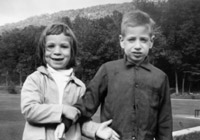
The secret was my brother, Alan, who in 1950 was born with striking blue eyes and a form of autism that hindered his ability to speak. Indeed, he has never spoken a word. |
|
|
|
|
Alan became a secret suddenly. In 1958, he was sent to live in Letchworth Village, a state-run institution for people with developmental disabilities (as well as deafness, dyslexia, and others). And after that day, almost all mention of him within the home virtually ceased. |
|
|
|
The shroud of secrecy that surrounded Alan's disappearance has prompted the filmmaker to probe delicately but persistently beneath the surface of the family's silence: to find answers to why and how Alan's placement occurred, and why so much was left unsaid. |
| |
|
|
And uncovering Alan's story and the reasons for the taboo uncovers a small trove of buried history, both public and deeply personal. Public includes the medical theories which blamed a woman for her child's autism, the institutional framework, which placed these large complexes for people with developmental disabilities in isolation, miles away from urban centers, a shocking Geraldo Rivera expose of conditions within the institution; accompanying these was a world of shame, which prevented an entire family from ever mentioning the existence of their child. |
|
|
|
Without Apology travels an historical sweep, charting the gradual changes in all these systems. After the relatively recent, radical overhaul of perceptions of people with mental retardation and the intervention of the civil rights movement, Alan is emerging as a member of his family, and of the world. And although he cannot speak, his oddly appealing presence weaves together the narratives of his family, friends and staff. |
|
|
|
|
|
Told from Alan's sister's point of view, and with stylistic inventiveness, Without Apology traces the transformation which took place for the other members of the family as well; it was a gradual change, which paralleled the closing of the institution and Alan's second placement — this time to a group home, a suburban split level with seven other men.
This documentary fully reflects this history in the faces and words of the filmmaker's family members, challenged to reassess Alan's place in their lives. Her mother can claim that she's "come out of the closet." (And once she recovers from the "bombshell," she applauds her daughter/filmmaker for making their family "secret" the subject of a film.) When Alan lived at Letchworth, they shunned public spaces. They now walk with him down crowded streets and into restaurants. But the road isn't always easy. Without Apology is Susan Hamovitch's attempt to reclaim her family's past, finding, in the process, a tangle of family shame, social history, and ultimately a new, unique relationship with her brother. Sometimes shattering, sometimes touching, always honest, it's a story that can only be told now that Alan can be seen...without apology. |
|
|
|